Oct 1, 2026 · Forklift · 3 Min Read
Forklift Stability Triangle Explained
TradeCertPrep.ca Editorial Team
Author
Why forklifts tip and how to prevent it: the stability triangle, load centre, capacity plates and safe driving on ramps, explained in plain language.
Tip-overs are among the most serious forklift incidents, and they almost always come down to the same few ideas: where the weight sits, how high it is carried and how the truck is driven. This article explains those ideas so the rules you are taught make sense rather than feeling like a list to memorize.
The stability triangle
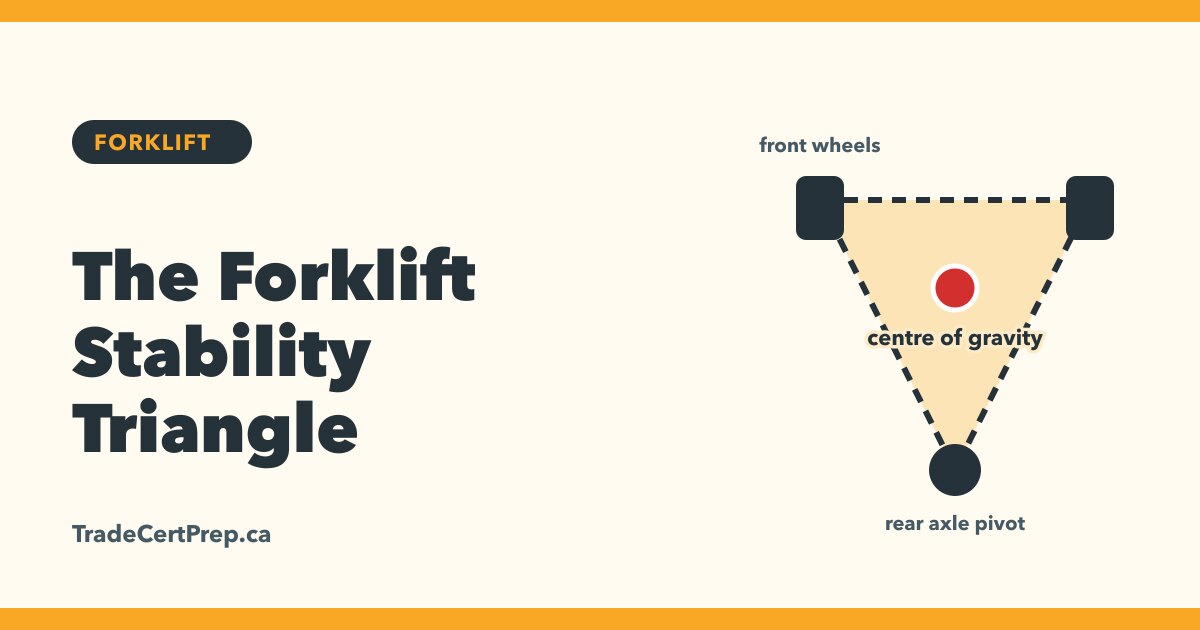
A counterbalance forklift is supported at three points: the two front wheels and the pivot point of the rear axle. Draw lines between them and you get a triangle. As long as the combined centre of gravity of the truck and its load stays inside that triangle, the truck stays upright. When it moves outside, the truck can tip forward or sideways.
Raising a load, turning sharply, travelling fast or driving over uneven ground all push the centre of gravity toward the edge of the triangle.
Load centre and rated capacity
Every forklift has a rated capacity that applies to a load of a specified size with its weight centred a set distance back from the front of the forks. This distance is the load centre. If the load's centre sits farther out than the rated distance, which happens with long or bulky loads, the truck can safely lift less than its headline capacity.
The same applies when you add attachments such as fork extensions or clamps. They usually reduce the safe capacity of the truck.
Read the data plate
The data plate (also called the capacity plate) is mounted on the truck and tells you its capacity at different load centres and, where it applies, at different lift heights and with different attachments. Before lifting, check the weight and size of the load against that plate. Do not guess, and never assume a load is within capacity because it looks light.
Carrying a load safely
- Travel with the load low, just high enough to clear the ground and small obstacles, with the mast tilted slightly back.
- Keep the load as close to the mast and as centred on the forks as you can.
- Avoid sharp turns, especially with a raised load, because sideways force can tip the truck.
- Slow down on wet, uneven or oily surfaces and report the hazard.
- If the load blocks your view forward, travel in reverse or use a trained spotter.
Ramps and slopes
The general rule is to keep the load on the uphill side. A loaded truck drives up a ramp forward and down a ramp in reverse. An empty truck does the opposite, driving up in reverse and down forward, with the forks pointing downhill. Do not turn on a slope.
Check your understanding
- Forklift Stability & Load Handling Practice Test.
- Forklift Fundamentals Practice Test.
- All forklift practice tests.
This article is an unofficial study guide. It does not replace the training your employer or an accredited training provider gives you, and rules and truck types vary, and your trainer and the truck's manual apply, so follow your site's procedures and your regulator's requirements.
Recent blog & articles
Fresh ideas, insightful stories, and the latest updates.
Forklift Pre-Operation Inspection Guide
What to check before every shift, when to take a forklift out of service, and the habits that keep pedestrians safe around powered lift trucks.
How to Read a WHMIS Safety Data Sheet
Every safety data sheet uses the same 16 sections in the same order. Learn which section answers which question so you can find what you need fast.