
Sep 28, 2026 · WHMIS · 2 Min Read
How to Read a WHMIS Safety Data Sheet
TradeCertPrep.ca Editorial Team
Author
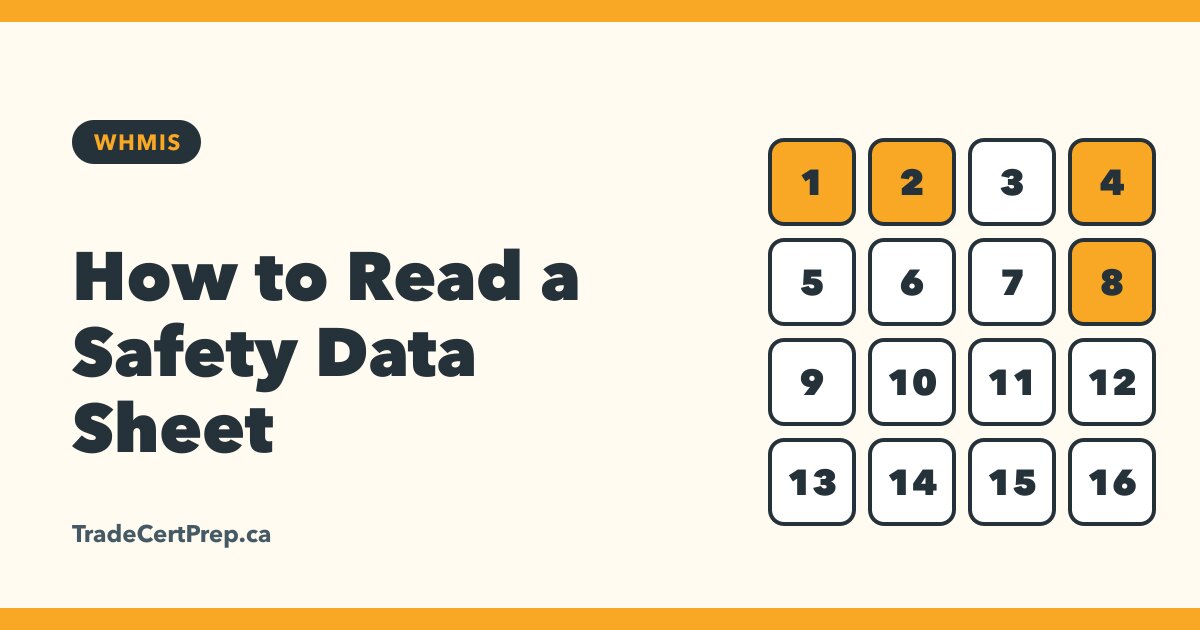
Every safety data sheet uses the same 16 sections in the same order. Learn which section answers which question so you can find what you need fast.
A safety data sheet (SDS) can run to many pages, which is why people rarely read one end to end. The good news is that every SDS under WHMIS 2015 uses the same 16 sections in the same order. Once you know what each section is for, you can go straight to the answer you need.
The 16 sections at a glance
- Identification: product name and supplier contact details, including an emergency phone number.
- Hazard identification: the classification, pictograms, signal word and hazard statements.
- Composition and ingredients: what is in the product.
- First-aid measures: what to do after skin or eye contact, inhalation or swallowing.
- Fire-fighting measures: suitable extinguishing methods and special fire hazards.
- Accidental release measures: how to respond to a spill or leak.
- Handling and storage: safe handling practices and storage conditions.
- Exposure controls and personal protection: exposure limits, ventilation and the personal protective equipment (PPE) to use.
- Physical and chemical properties: appearance, flash point and similar data.
- Stability and reactivity: what the product reacts with and conditions to avoid.
- Toxicological information: health effects and routes of exposure.
- Ecological information: effects on the environment.
- Disposal considerations: how to dispose of the product and its container.
- Transport information: shipping classification.
- Regulatory information: other rules that apply to the product.
- Other information: includes the date the SDS was prepared or last revised.
Match the question to the section
- Someone got a splash in the eye: Section 4.
- What gloves or respirator should I use: Section 8.
- There is a spill on the floor: Section 6.
- Can I store this next to that product: Section 7 and Section 10.
- Who do I call about this product: Section 1.
SDS or label?
The label is the quick reference on the container, and the SDS is the detailed technical document. They should agree, because both come from the same classification. If you need to decide how to respond to an incident, the SDS is the place to look.
Who provides it and who keeps it current
The supplier creates the original SDS and provides it with the product. Employers obtain SDSs and make sure workers can reach them readily during their shift, whether on paper or electronically. Many workplaces treat an SDS that is more than three years old as a prompt to ask the supplier for a current version, and the revision date in Section 16 tells you how old yours is.
Practise reading them
- WHMIS Safety Data Sheets Deep-Dive (10 questions on sections and responsibilities).
- WHMIS Fundamentals Practice Test for the full picture.
This article is an unofficial study guide. It does not replace the training your employer or an accredited training provider gives you, and rules can differ by province or workplace, so follow your site's procedures and your regulator's requirements.
Recent blog & articles
Fresh ideas, insightful stories, and the latest updates.
Forklift Pre-Operation Inspection Guide
What to check before every shift, when to take a forklift out of service, and the habits that keep pedestrians safe around powered lift trucks.

Forklift Stability Triangle Explained
Why forklifts tip and how to prevent it: the stability triangle, load centre, capacity plates and safe driving on ramps, explained in plain language.